
Life is unpredictable. Unexpected expenses—like a car repair, medical bills, or sudden job loss—can throw anyone off balance financially. That’s where an emergency fund comes in. Think of it as your financial safety net, a stash of money set aside to handle life’s surprises without stress.
I’m Muhammad Saad Samar, and over the years, I’ve learned that building an emergency fund isn’t complicated—but it does require discipline, planning, and consistency. In this guide, I’ll walk you step by step on how to create your own emergency fund, even if you’re starting from scratch.
What Is an Emergency Fund and Why You Need One
An emergency fund is money set aside exclusively for unexpected expenses. Unlike your regular savings for vacations or gadgets, this fund is untouchable unless a true emergency arises.
Why it matters:
- Financial security: You don’t have to rely on loans or credit cards during tough times.
- Peace of mind: Knowing you have a buffer reduces stress and worry.
- Avoid debt: Emergencies can be expensive. Having money ready prevents high-interest borrowing.
Example from my life:
A few years ago, my laptop suddenly stopped working. Instead of taking a loan, I used my emergency fund to replace it immediately. It was a small but stressful moment that became much easier thanks to the fund I had built.
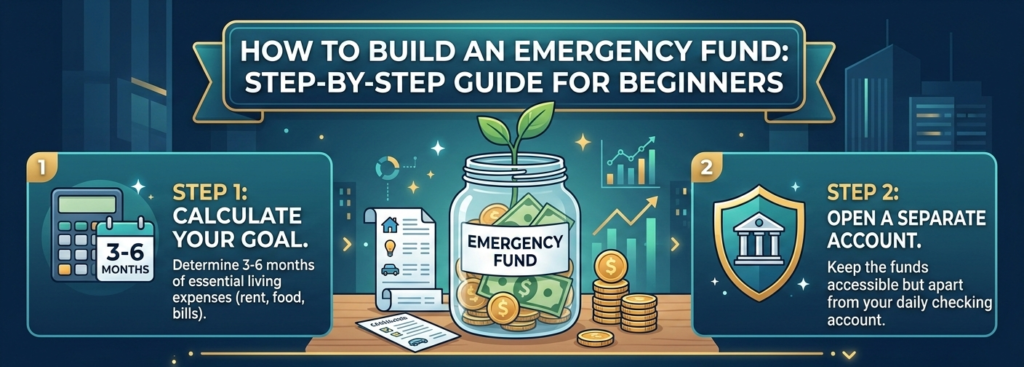
Step 1: Determine How Much You Need
The first step is figuring out how much money your emergency fund should cover. Most experts recommend 3–6 months of living expenses, but if you’re just starting, even $500 to $1,000 is a solid beginning.
How to calculate:
- List all essential monthly expenses: rent/mortgage, groceries, utilities, transportation, insurance, and debt payments.
- Multiply by the number of months you want your fund to cover.
Example:
- Rent: $500
- Utilities & bills: $150
- Groceries: $250
- Transportation: $100
Total monthly expenses: $1,000
If you want a 3-month emergency fund → $1,000 × 3 = $3,000
Start with a smaller goal if $3,000 feels overwhelming. The key is starting now, not waiting for the perfect number.
Step 2: Open a Separate Account
To avoid accidentally spending your emergency fund, it’s best to keep it separate from your regular checking account.
Options include:
- High-yield savings account
- Money market account
- Online savings account
Tips:
- Make it easy to access in an emergency but not too easy to dip into casually.
- Look for accounts with no fees and decent interest, so your money grows a little while sitting there.
Personal tip:
I opened a dedicated savings account labeled “Emergency Fund.” Every month, I transferred a small amount automatically. Seeing it grow slowly motivated me to keep going.
Step 3: Set a Realistic Monthly Goal
Building a fund overnight is impossible for most people. Instead, set achievable monthly targets. Even small amounts add up over time.
How to start:
- Calculate how much you can comfortably save without affecting essentials.
- Start with as little as $50–$100 per month.
Example:
If your monthly expenses are $1,000 and you save $100 each month, in 6 months you’ll have $600. It’s not the full goal yet, but it’s a strong start—and motivation builds as you see the balance grow.
Step 4: Automate Your Savings
One of the best ways to grow an emergency fund is to make saving automatic.
How to automate:
- Set up an automatic transfer from your checking account to your emergency fund each month.
- Align it with payday, so it happens before you’re tempted to spend the money.
Why it works:
- You don’t have to rely on willpower.
- Small, consistent deposits add up over time.
- It becomes a non-negotiable expense, just like rent or bills.
Personal insight:
I automated $50 per month into my emergency fund. I barely noticed the money missing, but after a year, I had $600 saved—enough for a minor emergency without stress.
Step 5: Cut Unnecessary Expenses
If your goal feels unreachable, look for ways to free up extra money. You don’t need to deprive yourself entirely—just find small areas to cut back.
Tips:
- Cancel unused subscriptions (streaming, apps, memberships)
- Cook at home instead of eating out frequently
- Buy generic brands for groceries
- Reduce impulse online shopping
Example:
I realized I was spending $30/month on coffee from cafés. Switching to home-brewed coffee three times a week saved $20 monthly. That extra $20 went straight into my emergency fund.
Even tiny savings compound over time. The key is redirecting them to your fund instead of casual spending.
Step 6: Find Additional Income Sources
If your budget is tight, consider earning extra money to boost your fund. This doesn’t have to be permanent—it can be a temporary push to reach your goal faster.
Ideas:
- Freelance work or side gigs
- Selling unused items online
- Small tasks or micro-jobs (surveys, online tutoring, etc.)
Example:
I sold a few old books and gadgets I wasn’t using anymore. That extra $100 went straight into my emergency fund, and it made a noticeable difference in my progress.
Step 7: Avoid Temptation to Spend
The biggest challenge for many beginners is resisting the urge to dip into the fund for non-emergencies.
Tips:
- Clearly label your account “Emergency Fund.”
- Treat it like untouchable insurance money.
- If temptation strikes, wait 24 hours before making a withdrawal—often the urge fades.
Pro tip:
I once almost used my fund for a gadget upgrade. I paused, thought about its purpose, and realized it wasn’t an emergency. Waiting saved me money and kept my fund intact.
Step 8: Reassess and Adjust
Life changes—your expenses, income, and emergencies may shift. Periodically review your fund and goals.
Questions to ask yourself:
- Has my monthly expense total changed?
- Should I increase my monthly contributions?
- Am I close to my target?
Tip:
Every 3–6 months, check your progress. Adjust deposits if possible. It keeps your fund on track and reinforces the habit of saving.
Step 9: Celebrate Milestones
Building an emergency fund is a long-term habit. Celebrate progress to stay motivated.
Examples:
- Reaching the first $500 saved
- Covering one full month of expenses
- Halfway to your target
Why it works:
Celebrating milestones keeps the process enjoyable and reminds you that every small effort counts.
Personal note:
I remember celebrating the first $1,000 in my fund by treating myself to a small coffee outing. It didn’t break the bank, but it reinforced my habit.
Common Mistakes to Avoid
- Using the fund for non-emergencies: Treat it strictly for unexpected situations.
- Setting unrealistic targets: Start small. Even $50/month is progress.
- Stopping contributions once partially funded: Keep building until you hit your full goal.
- Ignoring inflation and rising costs: Recalculate expenses periodically.
Final Thoughts
Building an emergency fund is one of the smartest financial moves a beginner can make. It doesn’t require a huge salary or perfect financial knowledge—just discipline, consistency, and a plan.
Remember:
- Start small and be consistent.
- Automate your savings whenever possible.
- Cut unnecessary expenses and redirect them to your fund.
- Avoid temptation to spend unless it’s a true emergency.
With patience, your emergency fund will grow into a financial safety net that brings peace of mind and protects you from life’s surprises.
I’m Muhammad Saad Samar, and I share my personal experiences and tips for financial independence. This content is for informational purposes only and is not financial advice. Please do your own research before making any financial decisions.
FAQs
Q: How much should a beginner aim to save first?
A: Start with $500–$1,000. Once that’s secure, gradually build to 3–6 months of living expenses.
Q: Can I use my emergency fund for planned expenses?
A: No. Use it strictly for unexpected events like medical emergencies, urgent repairs, or sudden job loss.
Q: How long does it take to build a full emergency fund?
A: It depends on your monthly contributions. Even $50/month can grow steadily. Reaching a 3-month expense goal may take 1–2 years for beginners.
| This content shares my personal experiences and tips for informational purposes only. It is not financial advice, and results may vary. Please do your own research before making any financial decisions.